AI Lip Sync vs Manual Dubbing: Which Localization Workflow Holds Up in 2026?
Highlights
- AI lip sync vs manual dubbing is no longer a purely technical question. In 2026, it is mostly an editorial workflow decision about speed, control, and how visible the speaker is on screen.
- Manual dubbing still wins when performance nuance, actor direction, or brand-specific voice delivery matters more than turnaround time.
- AI lip sync wins when you need faster localization for talking-head videos, demos, education content, and multilingual distribution tests.
- Tools like HeyGen and Descript now package translation, dubbed speech, and lip sync inside one workflow, while Wav2Lip remains a recognizable open-source reference point for developer-led pipelines.
- The strongest teams do not ask which method is “better” in general. They ask which method fits this video, this budget, and this review tolerance.
Most localization mistakes happen before the render. Teams compare AI lip sync and manual dubbing as if they were two output styles, but the real difference is in the workflow around them: how fast you can revise, how much human performance you need, and how much visual realism the viewer expects.
As of May 20, 2026, YouTube supports multi-language audio tracks and continues expanding automatic dubbing, which means more creators now have a practical reason to localize without splitting content into multiple channels. That makes the “AI vs manual” decision more common, not less.
This guide is built for that decision. It does not assume you are a studio. It assumes you have a real video, a real audience, and a real tradeoff to make.
What manual dubbing still does better
Manual dubbing is still the strongest option when the voice performance itself carries a large part of the experience.
That usually includes:
- scripted ads with tight brand tone
- emotionally complex character work
- cinematic storytelling
- premium training or internal executive communication
- videos where the speaker's personality depends on subtle delivery choices
Human performers can adjust phrasing, emphasis, hesitation, and rhythm with intent. They can also respond to direction. If a line needs to sound more restrained, more reassuring, more skeptical, or more playful, a skilled voice actor can usually get there faster than a model plus a chain of retries.
Manual dubbing is also easier to defend when the stakes are high. If a launch film, keynote, or flagship campaign will be watched closely by customers or partners, teams often prefer the predictability of a supervised human recording session.
That said, “manual” does not mean effortless. It usually brings more coordination: translation review, talent scheduling, recording, retakes, mix, and sync approval. That cost is not only financial. It is operational.
Where AI lip sync is clearly stronger
AI lip sync is strongest when your bottleneck is volume, speed, or iteration.
That is why it fits well for:
- talking-head tutorials
- SaaS walkthroughs
- creator education videos
- webinar clips
- product demos
- sales enablement videos
- multilingual test distributions
The win is not that AI replaces every part of dubbing. The win is that it compresses the loop between “we need another language” and “we have a reviewable version.”
Current product workflows make that especially visible. HeyGen documents video translation with natural-sounding voice and lip sync in its API and product help, while Descript recommends translating captions first, then applying dubbed speech and lip sync as a final step. Those product decisions tell you something important: the most reliable AI workflows are still built around review, not blind automation.
If your video already has a clear face on screen, good lighting, and a stable shot, AI lip sync often gets you to a good-enough localized version faster than a traditional dubbing process.
The tradeoff is really about revision cost
Here is the comparison most teams actually feel:
| Dimension | Manual dubbing | AI lip sync |
|---|---|---|
| Performance nuance | Strongest | Usually good, sometimes uneven |
| Revision speed | Slower once talent is involved | Faster for script and timing changes |
| Workflow complexity | Higher coordination overhead | Lower coordination, more software dependency |
| Best footage type | Broad range of content | Best on clearly visible speakers |
| Scaling to many languages | Heavier operationally | Easier to test and expand |
This is where AI changes the economics of localization, even when the output is not perfect. If you expect five small revisions after stakeholder review, the workflow that absorbs revisions more cleanly often wins.
The biggest mistake is comparing first-pass quality only. The better question is: which method gets us to approved quality with the fewest painful cycles?
When the viewer will actually notice the difference
Not every video needs lip sync at the same level.
If the speaker is tiny in frame, if the edit cuts often, or if the audience is focused on slides and screen capture, the viewer may care far more about audio clarity than mouth precision. In those cases, audio dubbing alone can be enough.
If the speaker stays large in frame for long stretches, the viewer notices misalignment quickly. That is the environment where AI lip sync or careful manual post work matters much more.
Descript's own help documentation says lip sync works best with one visible speaker, camera-facing footage, and minimal mouth obstructions. HeyGen makes a similar distinction by separating Audio Dubbing from Video Dubbing. That is a useful framing even if you never use those products directly:
- choose audio-only localization when the face is not the center of attention
- choose lip-synced localization when the face is the product experience
This is also why open-source tools like Wav2Lip remain relevant. They are not always the easiest option, but they make the category boundary obvious: lip sync is a visual alignment problem layered on top of audio translation, not a replacement for translation quality.
A practical decision framework
Use manual dubbing when:
- one video carries high reputational risk
- performance direction matters as much as translation
- the content has strong emotional or dramatic tone
- your team already runs a mature voice production process
Use AI lip sync when:
- you need faster turnaround
- you are testing demand in new languages
- the content is informational and speaker-led
- you expect multiple review rounds
- the visible speaker remains centered and well lit
Use a hybrid approach when:
- you want AI for most back-catalog content
- you reserve human dubbing for hero assets
- you want to test localized audience response before investing in a studio workflow
That hybrid model is often the most rational one. It lets you move quickly without pretending every video deserves the same production cost.
What this means for YouTube and product teams
YouTube's multi-language audio feature changes the publishing side of the decision. You can now attach multiple dubbed tracks to a single video instead of cloning uploads across channels, which makes localization easier to manage and measure in one place.
That does not mean you should localize everything. It means you can start with the videos that already prove demand.
For product teams, the same logic applies. If you are deciding whether to localize onboarding, tutorials, or short demos, the fastest path is usually a controlled AI workflow first. Inside LipSyncX Studio, that means finalizing your source cut, approving the translated script, then treating lip sync as the finishing pass rather than the experimental starting point.
If the viewer experience still feels too synthetic after review, that is your answer. Move that content category up to a manual or hybrid process.
Where LipSyncX fits
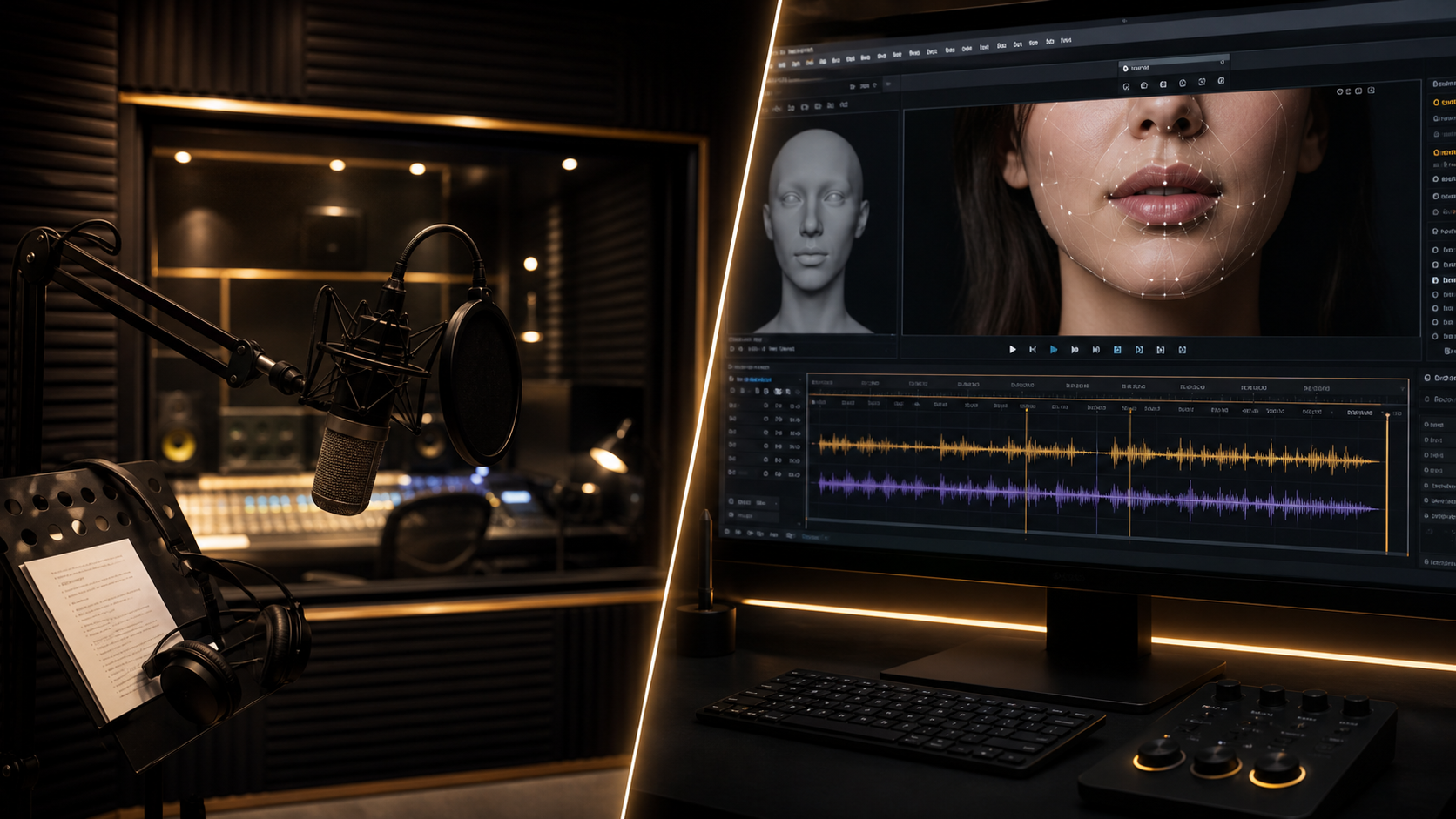
If you need a browser-based localization workflow, LipSyncX's AI video dubbing flow is strongest for teams that already know they are working with speaker-led footage and want a faster review loop.
The product bridge is simple:
- manual dubbing optimizes for performance control
- AI lip sync optimizes for faster iteration
If your team is still deciding which side matters more, the useful test is not a long debate. It is one representative clip. Localize one talking-head tutorial or demo, review the result, and compare the approval effort against your current workflow. If that render gets close enough fast enough, you have your answer.
The better question to end with
The best choice is rarely “AI forever” or “manual forever.” It is matching the workflow to the content.
If the video depends on acting nuance, brand-sensitive delivery, or premium emotional performance, manual dubbing still has a strong place. If the video depends on speed, repeatability, and getting localized content into review without weeks of coordination, AI lip sync is usually the better operational tool.
That is the real comparison in 2026: not machine versus human in the abstract, but which workflow gets your team to a believable localized video with the least waste. If you want to test that with a real project, start with one high-visibility speaker clip, run it through LipSyncX pricing expectations and workflow constraints, and judge the result from the review table, not the marketing copy.