
How Many Credits Do I Need for a 10 Second Video?
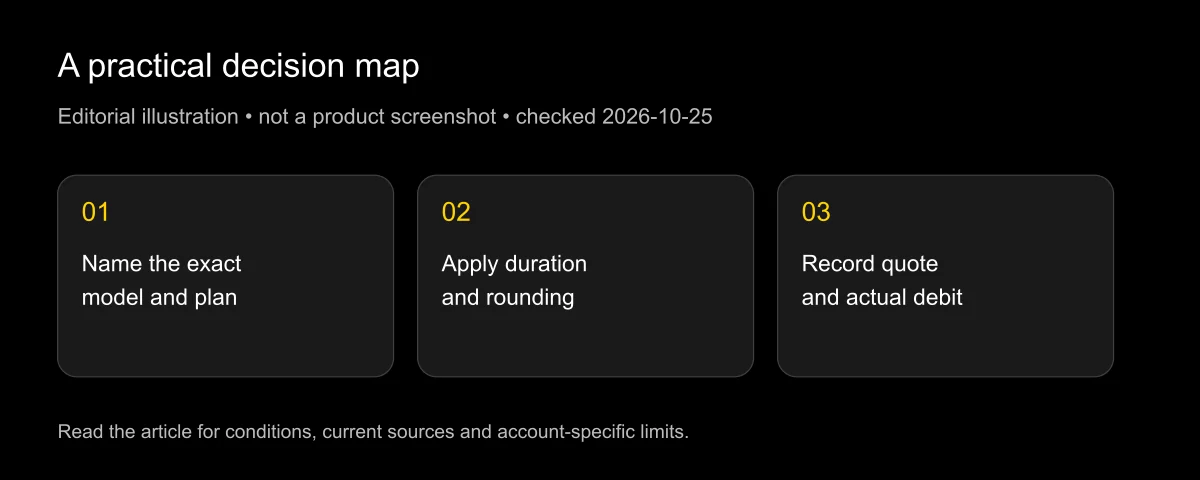
The credits needed for a ten-second lip sync video depend on the tool, model, billing family and rounding rule. There is no standard credit shared by HeyGen, D-ID, Sync or LipSyncX. Start with the selected model's rate, then confirm the generation quote before submitting.
Checked: 2026-10-25. The table is documented arithmetic, not a new paid-account debit test. A separate historical example below is dated 2026-10-12. LipSyncX publishes this article and sells related products; those records are first-party evidence, not independent testing.
A ten-second credit estimate is useful only when it names the model and rounding rule. Never compare two providers' raw credit counts as if the currencies had equal value.
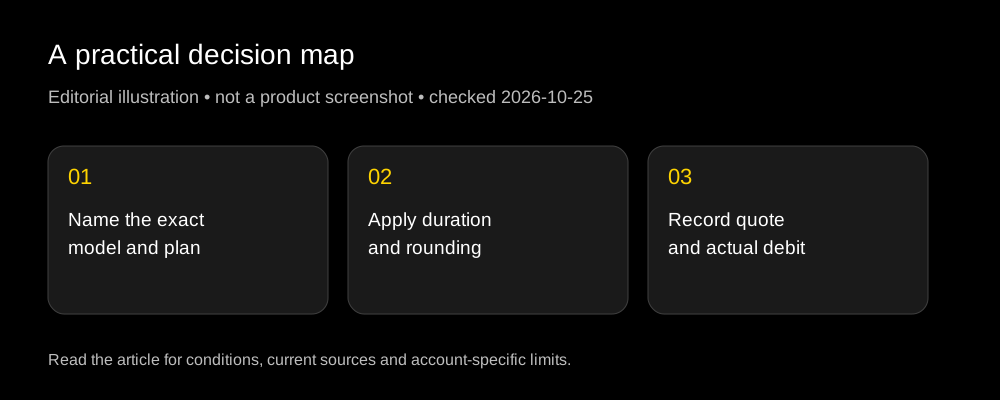
The ten-second conversion table
| Tool and feature | Documented unit | Ten-second calculation | Status |
|---|---|---|---|
| HeyGen Avatar III Photo Look | 7 credits/minute | 7 × 10 / 60 = 1.17 | Proportional estimate; debit rounding unverified |
| HeyGen Avatar IV Photo Look | 16 credits/minute | 16 × 10 / 60 = 2.67 | Proportional estimate; debit rounding unverified |
| HeyGen Avatar V Photo Look | 48 credits/minute | 48 × 10 / 60 = 8 | Model-specific estimate |
| D-ID duration allowance | Round upward in 15-second intervals | ceil(10 / 15) × 15 = 15 seconds | Billable allowance, not a universal cash price |
| Sync credit-billed lipsync-2 | About 5 credits/sec at 25 fps | 10 × 5 ≈ 50 | Approximate; final output frames determine usage |
| Sync credit-billed lipsync-2-pro | About 8.3 credits/sec at 25 fps | 10 × 8.3 ≈ 83 | Approximate, not an observed debit |
| Sync credit-billed sync-3 | About 13.3 credits/sec at 25 fps | 10 × 13.3 ≈ 133 | Approximate, not an observed debit |
Sources: HeyGen's credit-rate guide, D-ID's duration FAQ and Sync credit billing. D-ID's current public page expresses the allowance in minutes; this table does not relabel every account as a one-credit-per-block system.
Why can't I just divide the per-minute rate by six?
You can divide by six to get a proportional estimate for exactly ten seconds. What that does not establish is how a particular product rounds fractions, handles minimums or measures the final duration.
An audio file displayed as “0:10” may contain a fractional second beyond ten. An editor may add a pause, or a workflow may extend a scene. If the charging boundary is fifteen seconds, crossing from 15.0 to 15.1 seconds can move you into another interval.
HeyGen also warns that rates can vary by account and region. A correct calculation using the public standard rate can still differ from your account's valid quote. Save the displayed rate and estimate together, rather than arguing from a comparison table alone.
For the dollar side, use the cost-per-video guide. Included plan credits and separately purchased top-up credits can have different effective cash costs.
Sync credits are different from legacy usage billing
Sync has credit-billed organizations and legacy subscription-plus-usage organizations. The latter can be billed for generated frames without a prepaid credit balance. Check your account family before looking for a credit debit that your billing system does not use.
For credit accounts, the quoted per-second summaries assume 25 fps. The provider says lip sync consumption is frame based. A longer output or a different frame count can therefore change the final usage.
Voice production and dubbing can be separate operations. If you first generate speech and then synchronize a face, do not assume the lip sync estimate includes the voice step. Record both quotes when building the total.
Free Sync accounts use generation allowances rather than paid credits. A ten-second trial can consume one available generation even though it would be described using credits on a paid account. That is not a contradiction; the systems measure different entitlements.
A historical debit example, clearly separated
An existing first-party project record contains a corrected ten-second singing-photo pair from 2026-10-12. The source audio was trimmed to include vocals near the beginning; earlier instrumental-only attempts were excluded from quality comparison.
| Historical run | Selected model | Input duration | Recorded credits |
|---|---|---|---|
| LipSyncX | LipSyncX 2.0 Pro, 720p selection | 10 seconds | 40 |
| Lip-Sync.ai | Singing 1.0 | 10 seconds | 10; recorded balance 20 → 10 |
This does not show that one service cost one-quarter as much in dollars. The credit currencies, models and cash purchase terms differ. The record also does not establish current 2026-10-25 pricing or a quality winner.
A sanitized historical calculation record contains only the fields needed to understand the example. The private source manifest includes operational identifiers and has not been published in full. No new HeyGen, D-ID or Sync paid debit is claimed.
How do I verify my own quote?
- Finish a permitted ten-second source and select the exact model.
- Note the input duration and any generated-output duration setting.
- Save the displayed estimate, plan family and balance before submission.
- Run a single job with no parallel jobs spending from the same balance.
- Record the final debit, refund if any, output duration and frame rate.
- Compare the difference with the provider's rounding and feature rules.
If the numbers do not match, keep the job timestamp and invoice privately for support. A screen recording of other people's faces or an account screenshot containing email addresses should not become public evidence without appropriate handling.
For a straightforward baseline, open the AI lip sync workspace with your finished audio. Use the generator guide to choose a workflow before comparing its quote.
Mistakes that make the estimate unreliable
Changing the model after calculating. A per-minute table is meaningful only for the model row you selected. Higher resolution or additional motion features can add separate consumption.
Using the plan's headline credit count as a video count. A pool of credits says little until you know the debit rate and whether other features draw from the same pool.
Ignoring expiration. Fifty credits you can use next month may have a different practical value from fifty that expire tonight. Read the expiration rules before purchasing a large allowance.
Calling an estimate a test. A formula produces an estimate. A recorded before-and-after balance plus job history produces debit evidence. Keep those labels separate.
FAQ
How many credits do I need for a 10 second video?
Use the selected model's rate and the provider's rounding rule. Examples above range from small fractional HeyGen estimates to approximately 50–133 Sync credits, but these are different currencies and workflows.
Does a ten-second clip always use less allowance than a fifteen-second clip?
No. A service charging upward in fifteen-second blocks can bill the same allowance for both. Check whether the product measures source length, processed length or final output.
Can I compare the historical LipSyncX debit with today's quote?
Use it only as a historical example. Model rates, offers and account conditions can change. Today's selected-model quote is the appropriate checkpoint for a new generation.
What should I do if the final debit is higher?
Check extra features, output length, frame count and rounding, then contact support with the private job record if the discrepancy remains. Do not publish account identifiers to demonstrate a billing question.
Check the number before you render
Select the actual model in the lip sync workspace, record its ten-second quote and keep one clean job record. Scale the project only after you understand that first debit.
Update record: 2026-10-25: reviewed model rates and billing families; added a separately dated historical example. Current account quotes govern actual debits. No present-day cross-vendor billing test has been performed.