
Is There a Free AI Lip Sync Trial? Limits Worth Testing
Yes, there are free AI lip sync trials, but a free generation is usually a limited evaluation, not a publish-ready commercial video. Check the model, maximum duration, export watermark and usage rights before uploading. A trial that accepts a photo also tests a different workflow from one that modifies an existing speaking video.
Checked: 2026-10-25. This guide compares public documentation, not newly generated test results. LipSyncX publishes this article and sells related tools; that commercial interest is disclosed. No affiliate payment or independent lab certification is claimed.
A useful free AI lip sync trial answers one production question with your own permitted material. It does not need to finish the entire project to be valuable.
What do you actually get for free?
Treat the following as a dated starting point. The signed-in account can differ by region, rollout or legacy plan; record what you see before spending a limited attempt.
| Service | Public free allowance | Duration | Card | Watermark and scope |
|---|---|---|---|---|
| HeyGen | Public pricing advertises 3 videos monthly | Up to 1 minute each | No card required | Watermarked; verify the feature available in your account |
| Sync | 3 lip sync generations monthly, including at most 1 sync-3 generation | 20 seconds generally; 15 seconds for sync-3 | No card required | Watermarked; Studio and API evaluation |
| D-ID Studio | $0, 14-day trial with 3 shared minutes | Limited by remaining allowance; Video Translate has a 30-second trial cap | Mobile trial requires a card; web card requirement not established | Full-screen mark; personal use; photo/video avatars |
Sources: HeyGen pricing, Sync free-trial documentation, and D-ID Studio pricing FAQ. D-ID's live Studio cards were checked in a browser because their contents were missing from the initial text extraction. The three-minute pool is a total trial allowance, not three minutes per day or a recurring monthly free tier.
HeyGen's credit help article warns that free accounts can receive 1–3 videos depending on region. If your account shows fewer than the public pricing card, do not assume the missing generations will appear after uploading. Check the account entitlement first.
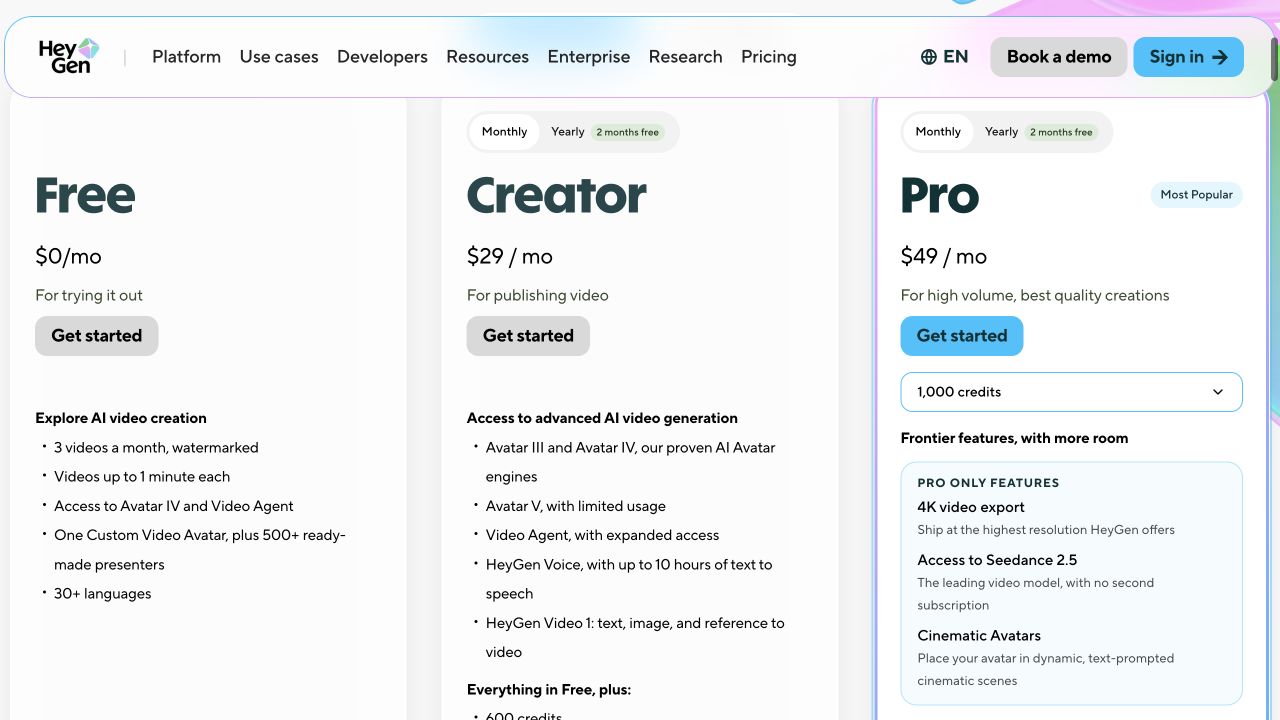
Official pricing-page screenshot, captured 2026-10-25. This is offer evidence, not an account-entitlement or output-quality test.
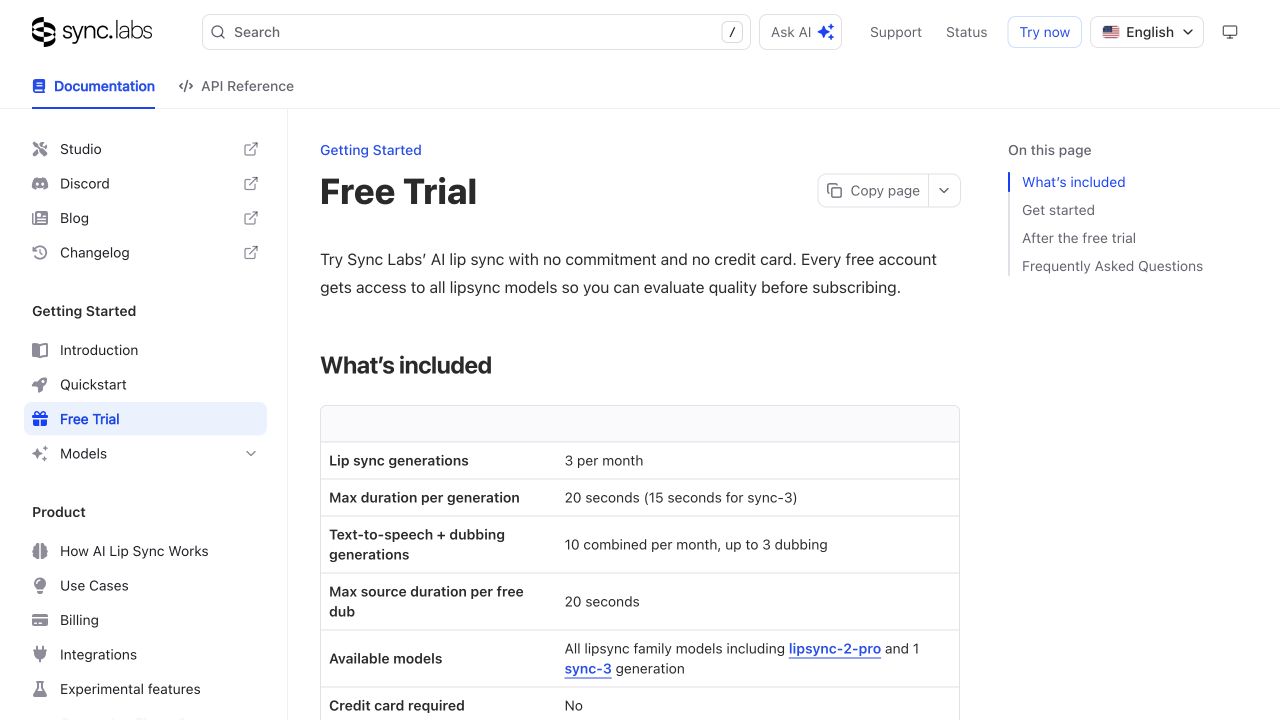
Official documentation screenshot, captured 2026-10-25. Read the live page and your account for changes.
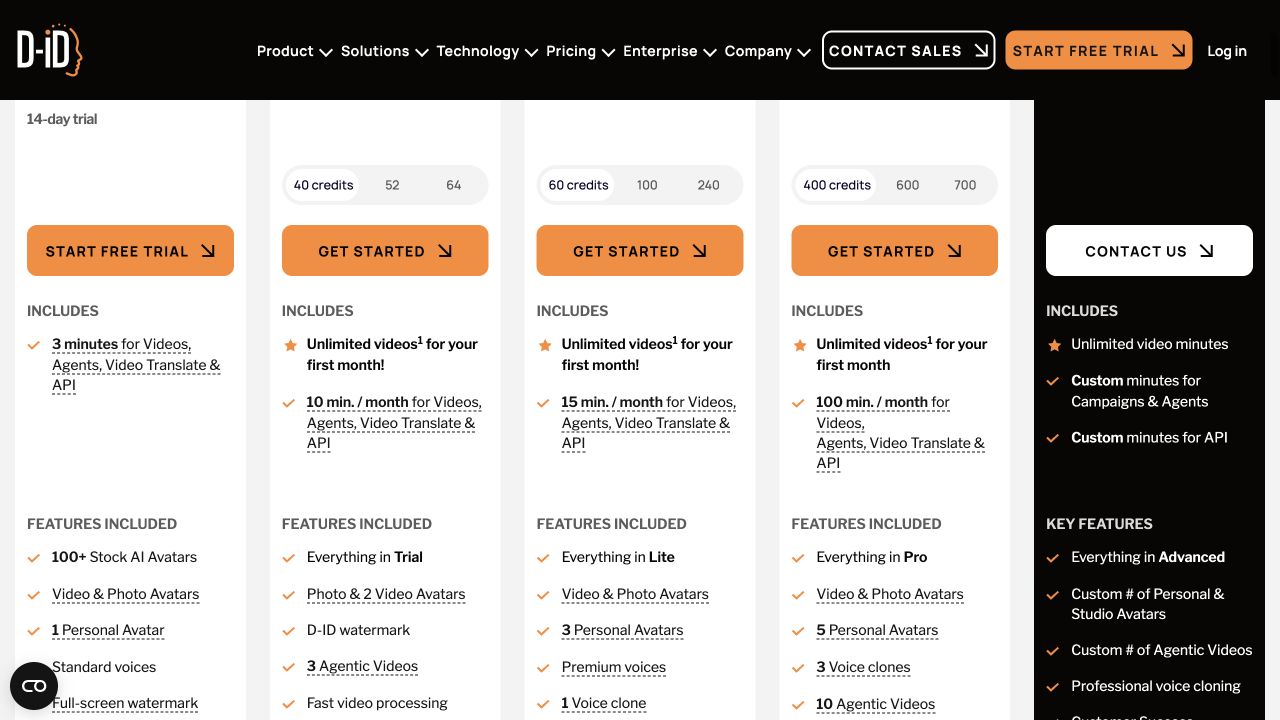
D-ID Studio trial card and feature evidence, captured 2026-10-25. Its mobile-trial help separately says to select a subscription and enter card details, with cancellation before trial end to avoid billing. Do not extend that mobile procedure into an unverified universal statement about the web signup.
Decide which workflow you need to evaluate
A talking photo starts with a still portrait and invents the motion needed to speak. Existing-video lip sync preserves a recorded performance while changing the visible mouth movements. An avatar platform may provide script entry, voice generation and a slide editor around that task.
These are different purchases. A one-minute avatar allowance does not prove that you can upload a one-minute music video, identify every speaker, replace the voices and download a clean commercial master.
Write a one-sentence brief before choosing a trial: “I need to animate a permitted portrait with my ten-second recording,” or “I need to replace one sentence in an existing interview.” That sentence prevents a free account from sending you into a feature that cannot answer your question.
For the first route, open the talking-photo workflow. For the second, use the AI lip sync workspace. Compare the broader categories in our 2026 generator guide.
How should you spend three trial attempts?
Use a small, controlled test instead of uploading three unrelated clips. These are recommended test steps, not results we have measured across the vendors.
- Prepare one baseline. Use your own clearly lit face or an appropriately licensed subject, one visible speaker and about ten seconds of clean speech. Keep the exact same source files for every candidate.
- Test a realistic challenge. Use a second clip with a modest turn or a brief hand movement if your intended footage contains one. Do not start with an extreme angle you would never publish.
- Reserve the final attempt. Fix one input problem revealed by the baseline, or compare the model that you could actually afford after upgrading.
- Download the original export. Judge the file itself, rather than a compressed preview or a promotional example.
- Keep a short review record. Save model name, date, source duration, output duration, visible watermark and whether the intended sentence is intelligible.
Replay the result once at normal speed with audio, once muted, and once while watching the lips around sounds such as “p,” “b” and “m.” The muted pass helps reveal implausible jaw motion that a convincing voice can distract you from.
Do not use a singing clip as your only speech test. Sustained vowels, musical timing and backing vocals add different challenges. A successful spoken greeting does not establish that the same settings will handle a chorus.
Which limits can make a trial misleading?
A duration cap is only one boundary. Other practical limits include queue priority, the models unlocked for the account, resolution, number of speakers and whether downloads are enabled. Record each one separately.
A short test can also hide an expensive failure. A stable ten-second portrait does not demonstrate that identity remains consistent over a long lesson, that rapid edits survive, or that twenty translated versions can meet the same deadline.
The opposite mistake is judging a tool on an unsuitable input. If a model expects speaking footage and receives a motionless image, failure does not tell you much about its intended dubbing use. Start with an input the vendor supports, then add difficulty relevant to your project.
If all three attempts fail, compare the symptoms before buying more. A cropped chin, quiet voice, overlapping speakers or music louder than the dialogue can survive every model upgrade. Spending money before fixing those inputs produces a larger bill without a clearer answer.
Do free generations or credits roll over?
A free generation allowance and a paid credit balance are separate systems. Do not assume rules from one apply to the other.
Sync says unused trial generations do not accumulate; moving to a paid subscription ends the free-generation allowance. That is a reason to test the free feature before upgrading, not a reason to rush an unsuitable upload. Its current credit plans and legacy usage plans also need separate billing checks. Sync trial conditions
For paid balances, use the dedicated credit-expiration comparison. Check the actual billing-period end date, not only the calendar month's final day. A subscription started on the seventeenth may follow a different cycle from a calendar-month trial allowance.
What does a free trial not prove?
It does not prove that the provider deletes your inputs immediately, never uses them for model improvement, or grants all rights needed for an advertisement. Those are policy and contract questions.
It also does not establish an average success rate. One successful export is evidence for that particular input and configuration. It is useful, but it is not a universal ranking, a turnaround guarantee or a reliable estimate of how many retries your next project will need.
Keep a rights check beside the quality check. Photograph ownership, the depicted person's permission, recorded voice permission and music rights can be separate. A trial's watermark is neither permission nor a complete disclosure policy.
Before sending a sample to a client, review its allowance, export watermark and usage rights together. Read the commercial terms before placing it in an advertisement, even if the sample looks ready to publish.
When is upgrading worth it?
Upgrade when a specific paid feature removes a verified blocker: a clean export, a longer supported shot, more useful concurrency or the commercial license your deliverable requires. Keep the test files so you can compare the paid result fairly.
Do not upgrade because a pricing card contains a larger number of credits. First estimate the model's cost for the actual project, the likely number of approved deliverables and the allowance you can use before expiration.
A sensible first paid project is one short deliverable with an agreed script and a fallback. Finish the audio first, confirm the source rights, render a sample, then approve the full run. That gives the purchase a clear success criterion.
FAQ
Is there a free AI lip sync trial without a credit card?
Yes. Sync explicitly documents a no-card free account, and HeyGen's pricing FAQ says its free plan does not require a credit card. Check the current signup flow and regional entitlement; D-ID documents a card requirement for its mobile-app trial; the web signup requirement is not established here.
Can I keep making new accounts to get extra free videos?
Do not treat that as a legitimate trial strategy. Follow the provider's account and usage rules. If the available allowance cannot test your project, ask about an evaluation or buy the appropriate small plan.
Can I publish a free test in a paid advertisement?
Only if the applicable license and all source permissions allow it. In particular, HeyGen's current terms distinguish Free evaluation output from paid-plan commercial output. Check the commercial-use guide before delivery.
Where are the side-by-side trial exports?
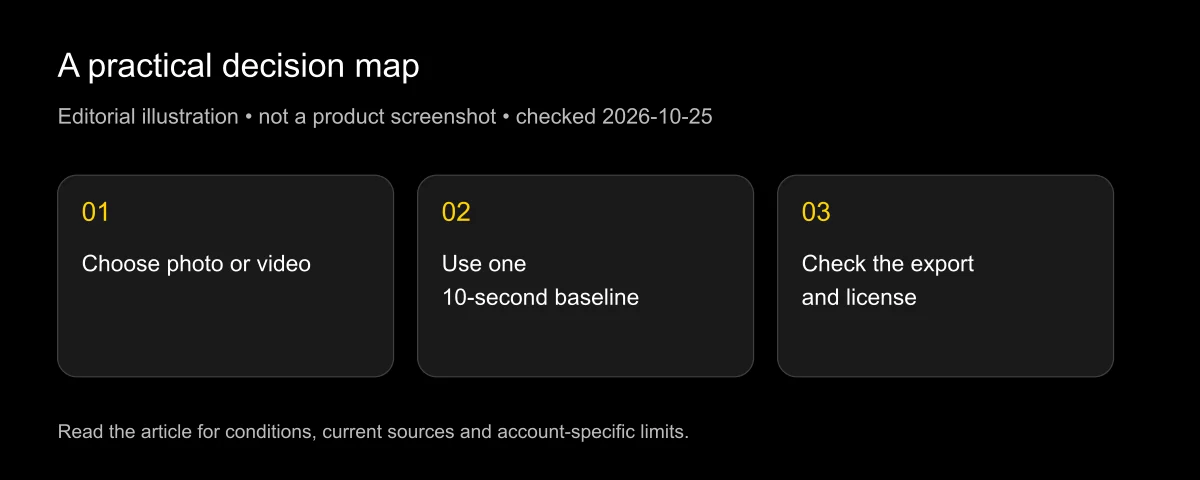
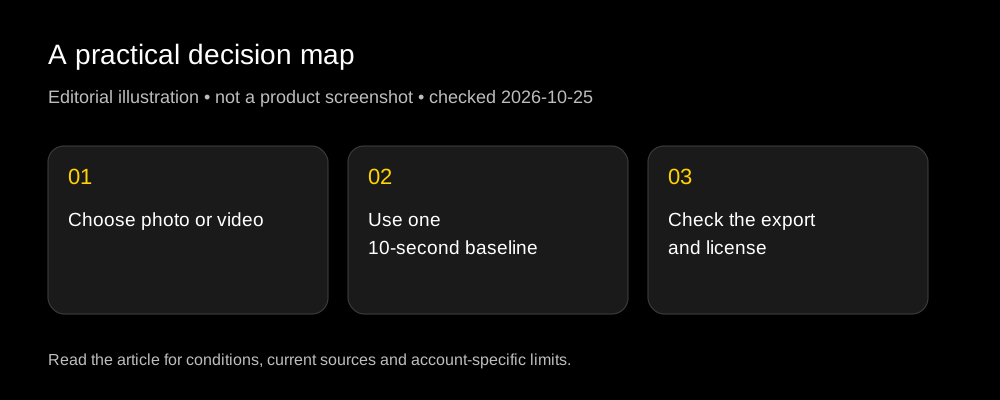
This is a documentation comparison. The official pricing and trial-documentation screenshots above were captured for this edition. No fresh cross-vendor exports or signed-in trial-account screenshots were collected, and the decision-map illustration is not a screenshot. Do not interpret the table as a measured quality or speed ranking.
Run one test with a clear question
Prepare a permitted ten-second source, write down the feature you must validate, and use the AI lip sync workspace or the relevant official trial. Save the export and its conditions before deciding what to buy.
Update record: 2026-10-25: reviewed official trial, pricing and account-limit pages. Prices, availability and terms can change; the current account and checkout govern the offer.