Can I Use AI Lip Sync Videos Commercially? Rights by Plan
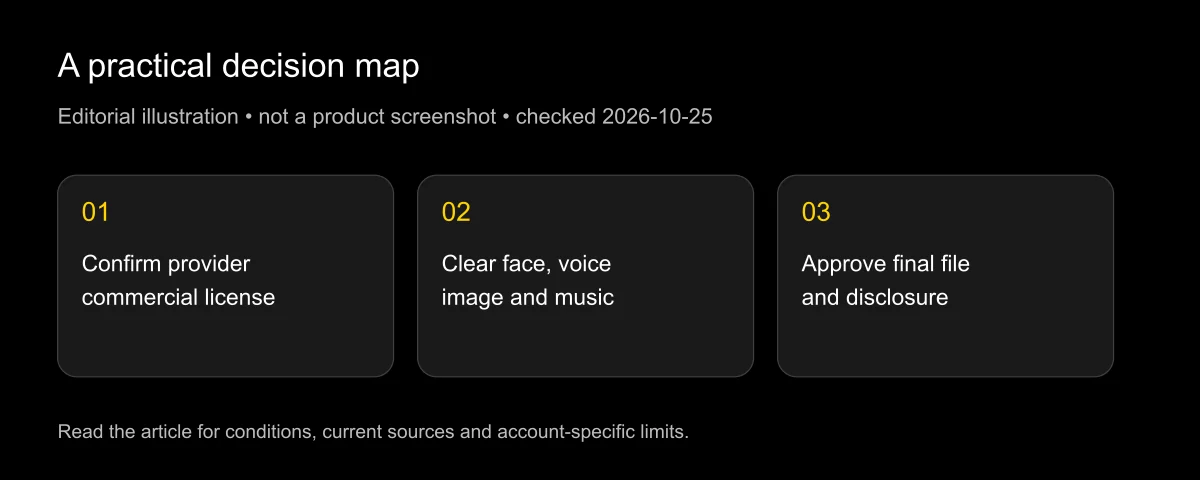
Yes, AI lip sync videos can be used commercially when the applicable plan permits the use and you have the necessary rights to the image, person, voice, script and music. A paid invoice alone does not clear those source rights. A free export or a clean frame alone does not establish a commercial license.
Checked: 2026-10-25. This guide summarizes current public terms and offers an editorial delivery checklist. It is not legal advice or a guarantee of advertising approval. LipSyncX publishes it and sells related products; we disclose that interest rather than presenting this as independent legal certification.
Commercial permission has two layers: the service must permit your intended use, and the underlying material must be yours to use that way. Passing one layer does not replace the other.
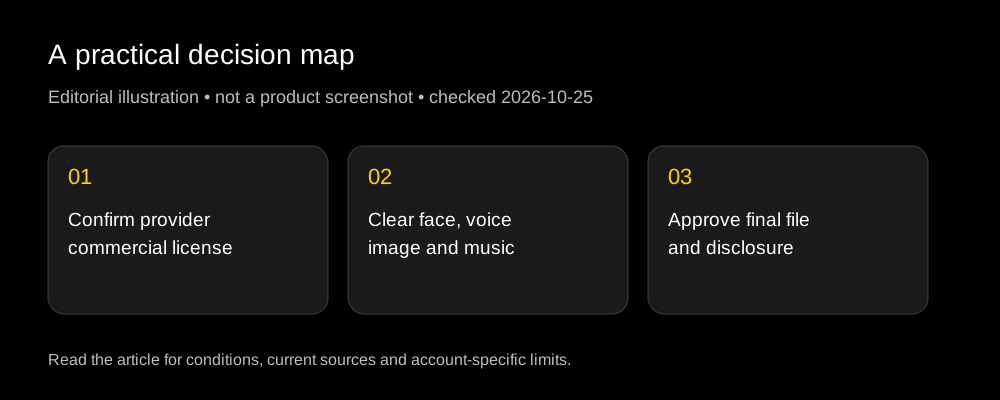
Which plans permit commercial use?
| Provider | Public position reviewed | Limit to preserve |
|---|---|---|
| HeyGen Free | Personal, noncommercial and internal evaluation output | Do not assume public pricing or an older FAQ grants client advertising rights |
| HeyGen Creator / Pro / Business | Commercial output permitted under the terms, with user responsibility for rights | Other content restrictions and termination provisions still apply |
| D-ID Trial / Lite / Build | Personal use | Social sharing is not a general commercial license |
| D-ID Pro / Advanced / Enterprise / Launch / Scale | Commercial use, assuming the uploaded image, audio and text rights are yours | Match the exact product family and tier |
| Sync | User-content rights and lawful-use obligations appear in the terms | This review does not infer a plan-wide commercial warranty or third-party rights clearance |
| LipSyncX | Check the current product terms and selected offer | This article does not itself grant a license |
The controlling references are HeyGen terms, D-ID's commercial-rights help page, D-ID product terms and Sync terms. Record the version applicable when you purchase and generate.
Policy: the table reports written provider positions. Inference: a plan marketed to businesses is not enough evidence to clear every proposed use. Not established here: whether a particular contract, region, stock asset or client campaign adds a separate restriction.
Why do older “free commercial use” answers become risky?
Terms can change while tutorials remain online. HeyGen's reviewed terms are updated October 15, 2026 and explicitly distinguish Free output from specified paid plans. A general statement copied from an old comparison can therefore answer a different contractual situation.
Check the current terms before creating a client master. If you generated an asset under an earlier offer, preserve the applicable version and ask the provider how it applies to that asset. Do not assume that a later upgrade retroactively changes the license for every previous export.
A useful production record links the generated file to its date, plan and license. That gives a client a traceable explanation when they ask why the video is appropriate for commercial delivery.
The same discipline applies to marketplaces and integrations. If a tool calls another provider's API, determine which agreement covers the service and whether included stock materials have their own terms.
Clear the photograph and the person's likeness separately
Owning the image file is not the same as owning the photograph's copyright or receiving the subject's permission for synthetic speech. A downloaded headshot can involve all three questions.
For a founder's product introduction, a practical permission record specifies the subject, approved script, intended channels, editing scope and how later revisions will be approved. This is an editorial checklist, not a universal contract template.
For an actor, presenter or employee, confirm that the agreement covers the actual AI use. Permission for an ordinary recorded interview may not answer whether you can generate new statements after filming has ended.
Be careful with implication as well as literal wording. Placing a familiar face beside a product can suggest endorsement even if the script never says “I recommend this.” A generic AI label does not supply that person's approval.
Clear the voice and music as their own assets
A permitted image does not clear a cloned voice. Check the speaker's consent, the voice-service license and any restrictions on impersonation or reuse. A client approving one narration is not automatically approving an unlimited reusable voice model.
Music adds more than the right to play a song privately. A commercial video can involve rights in the composition, the recording and the permitted way the track is synchronized and distributed. The exact rights depend on the asset and intended use; ask the rights holder or qualified adviser when uncertain.
For a singing-photo greeting, use your own appropriately cleared performance or an asset licensed for the intended commercial video. A platform music library may have different permissions for ordinary posts, paid ads and use outside that platform.
Keep the asset license with the project. If you later export the same clip to a different advertising channel, recheck the scope instead of assuming the original clearance follows it everywhere.
Does removing a watermark give me commercial rights?
No. Branding removal is an export feature, while commercial permission is a license condition. You can encounter a paid plan that retains a mark and a higher tier that replaces branding with a generic AI notice.
D-ID's watermark FAQ describes Trial/Lite branding, Pro/Advanced generic AI marks and Enterprise customization. Its live Studio pricing instead lists a custom logo on Advanced. Preserve that official-page discrepancy and confirm the actual export treatment; “commercial” and “unmarked” remain separate purchase questions.
Do not remove a required notice merely because an editor can crop or erase it. Check the provider's terms and obtain the approved export option. A client request for “no logos” should be resolved before you render the final job.
Use the trial and watermark allowance comparison for export conditions and the cost-per-video guide to calculate the plan that actually meets delivery requirements.
Check the destination's disclosure rules
A provider license does not guarantee distribution approval. Review the rules of the social platform, ad product, marketplace or learning platform where the final video will appear.
YouTube's current disclosure help requires disclosure for realistic generated or altered content in covered situations, including a real person appearing to say or do something they did not. Read its examples for the actual video rather than applying a blanket rule to every edit.
TikTok's AI-content guidance requires labeling realistic AI-generated image, audio and video content. An organic-post label is not a substitute for checking the separate rules of an advertising product.
Regional law can add obligations or restrictions. A label does not legalize deception, an unauthorized endorsement or an unlicensed soundtrack. This article does not assess a particular jurisdiction or campaign's legal compliance.
Three example projects and their unresolved questions
A founder's ten-second product introduction. The founder approves the script and use of their face and voice; the team uses an appropriately licensed plan and original music. That is a clearer starting point than a borrowed celebrity portrait, but the final claim, disclosure and distribution settings still need review.
An employee training presenter in five languages. The employer has a video release, but the team must check whether it covers synthetic translated speech, future reuse and a reusable avatar. Internal access should be limited, and the worker should know what will be generated.
A singing birthday promotion for a brand. A personal greeting becomes a commercial asset when used to advertise a product. The photo, likeness, singing voice, backing recording and plan all require review. Changing a familiar lyric or adding a logo does not automatically resolve those rights.
These are hypothetical scenarios. They illustrate the questions to ask; they are not legal determinations about real clients or accounts.
A client-delivery checklist
Before handing over a master, assemble a compact record:
- Provider permission: product, plan, generation date and applicable commercial terms.
- Visual rights: image ownership or license, subject permission and any restrictions on synthetic reuse.
- Audio rights: speaker consent, voice-model terms and music permissions.
- Approval: the exact script and final exported video accepted by the responsible person.
- Export treatment: required branding, AI mark, aspect ratio, captions and clean-master entitlement.
- Destination: disclosure setting and the rules for the actual publishing or advertising product.
Keep sensitive releases and account records private. A client needs enough documentation to understand the permitted use, not a public folder containing identity information or login details.
If you need a starting point for generation, use the talking-photo workflow only after the source permissions are clear. The face-upload guide covers data questions that remain even when a commercial license is available.
Keep client approval tied to the actual words
The approved video should correspond to the script the subject accepted. A last-minute change to price, product claims or a personal testimonial can alter what the person appears to endorse, even when the face and voice are technically unchanged.
Use a simple revision record: script version, language, intended channel, approver and final file. For translated material, have a suitable reviewer confirm meaning as well as pronunciation before the person is shown delivering it.
If a client wants to reuse the avatar for future campaigns, settle that scope before handing over reusable assets or account access. Delivering one rendered clip and transferring the ability to generate new statements are different practical arrangements. Ask the relevant rights holder and provider how the intended handoff is permitted.
What if the license is unclear?
Write down the exact use you want: who is depicted, what they say, which channel, whether the post is paid advertising and whether the client will reuse it. Then ask the provider or rights holder a question they can answer against that scenario.
A vague “Can I use this commercially?” can miss restrictions on client resale, stock avatars, voice cloning or particular industries. A specific description makes the response more useful.
Do not treat a casual support message as an amendment to a conflicting contract. Preserve it as clarification and ask for the applicable written provision or an authorized agreement if the difference matters.
If the needed rights cannot be established, change the asset or workflow before delivery. An original voiceover over product footage may solve the business problem without requiring a synthetic person.
FAQ
Can I use AI lip sync videos commercially?
Yes, when the service license permits the intended use and all relevant input, likeness, voice and music rights are cleared. Check the exact plan and current terms.
Can I use a free HeyGen video in client work?
The current reviewed terms limit Free output to personal, noncommercial and internal evaluation use. Do not rely on an older general FAQ for a new client advertisement.
Can I use D-ID Lite for business advertising?
D-ID's commercial-rights help classifies Lite with personal-use tiers. Review the current commercial tiers and product terms for your intended project.
Does permission survive cancellation?
Check the applicable output license and termination clauses. Ending renewal, breaching terms and deleting an account can have different consequences; this guide does not provide a universal continuing-rights guarantee.
Can I make a celebrity endorse my product if I label it AI?
A label does not supply permission to use a person's likeness or imply endorsement. Obtain the necessary rights or choose an appropriate authorized subject.
Clear the rights before the render
Use the checklist to approve the person, script, audio and plan, then open the lip sync workspace for one representative sample. Compare providers by workflow in the 2026 generator guide, and retain the conditions with the delivered master.
Update record: 2026-10-25: reviewed current provider terms, D-ID plan licensing and YouTube/TikTok disclosure guidance. Terms, platform rules and laws can change. Seek qualified advice for a specific commercial dispute or jurisdiction.