Is There a Lip Sync AI With No Subscription? Practical Routes
Yes, you can use lip sync AI without a recurring subscription. Pay-as-you-go APIs, limited free accounts and self-hosted models are the main routes. The tradeoffs are setup work, export limits, prepaid-balance conditions and licenses; a service that advertises usage pricing may still require a monthly access fee.
Checked: 2026-10-25. This is a review of current official documentation and an editorial buying worksheet, not a new paid benchmark. LipSyncX publishes this guide and offers related tools. We disclose that commercial interest and do not claim that one route is cheapest for every project.
No subscription means no recurring access commitment. It does not mean no charge, no account, unlimited use, permanent credits or unrestricted commercial rights.
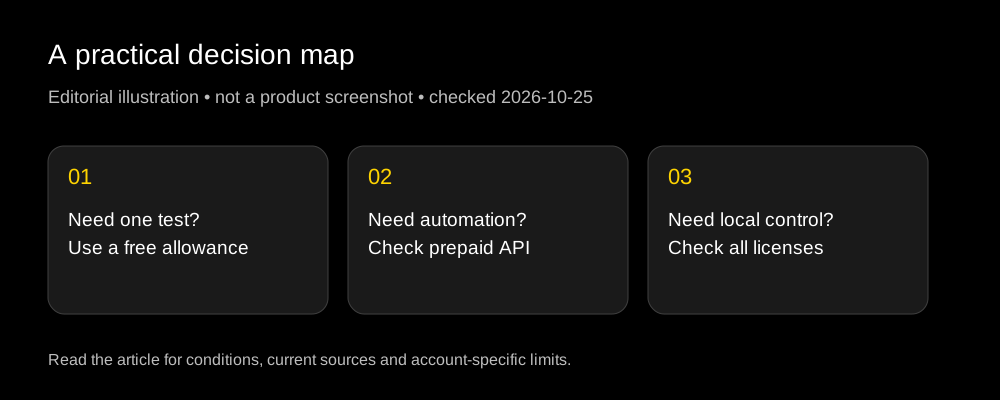
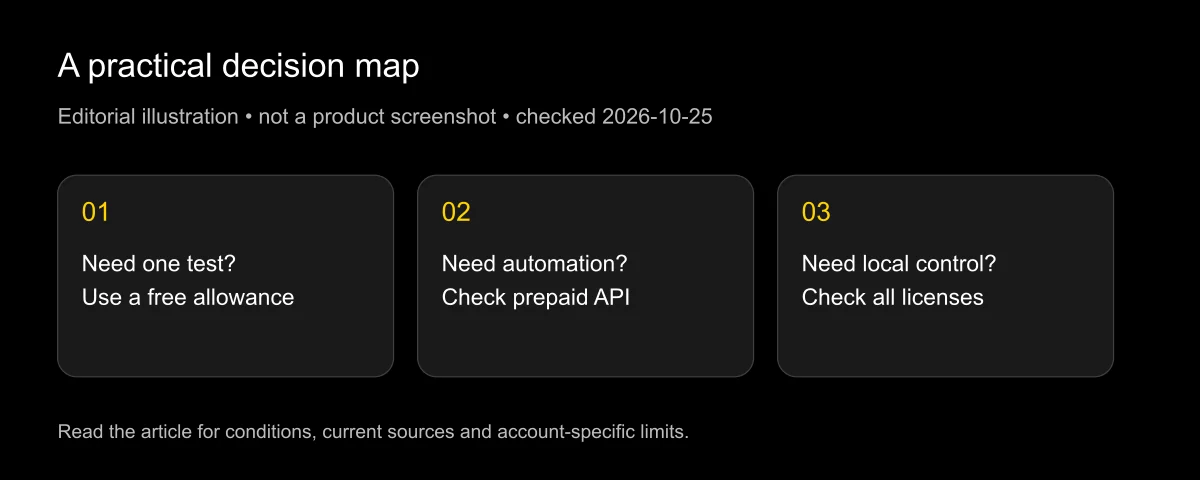
Which route fits your job?
| Route | Best starting question | Work you take on | Check before paying |
|---|---|---|---|
| Free account | Can this workflow handle my source? | Prepare a short test | Allowance, watermark, publishing rights |
| Direct pay-as-you-go API | Can I connect a workflow or write a small integration? | Authentication, submission, status checks, downloads | Endpoint pricing, expiration, minimum purchase |
| Model marketplace | Is the exact model available by usage? | Provider account and input handling | Current model rate and provider data policy |
| Self-hosted model | Can I run and maintain inference locally? | GPU, dependencies, updates, storage | Code, weights and data licenses |
| Short paid subscription | Would one bounded production month cost less? | Cancel or manage renewal on time | Recurring commitment and remaining balance |
The final row is a comparison option, not a no-subscription claim. It can be a rational purchase for a concentrated project, but it should be labeled honestly in a quote.
For photo animation versus re-voicing recorded footage, start with the categories in the 2026 generator guide. A service cannot save you money if it accepts the wrong kind of input.
Does HeyGen offer a no-subscription API?
Yes. HeyGen's API pricing help page states that its pay-as-you-go API is separate from regular web plans and does not require Creator, Pro or Business. The page describes API usage in US-dollar amounts and notes endpoint-specific limits.
That does not make a web subscription's allowance interchangeable with API funding. If you automate through another app, determine whose API key pays for the render and which balance is charged. A convenient integration can still have its own platform fee.
Before funding an account, open the endpoint you need and record its current unit, supported input, resolution and duration handling. A price for one avatar engine is not a universal rate for every translation or generation endpoint.
The public text extracted for this review did not expose the full numeric API rate table. We therefore do not print a guessed HeyGen API dollar rate. The no-subscription availability is verified; a job-specific price still requires the current endpoint or account quote.
Can a marketplace provide the same model without a direct subscription?
A marketplace can expose an individual model on usage terms. For example, Replicate's official sync/lipsync-2 API page lists $0.05 per second of output video. At that documented rate, a ten-second output is $0.50 and sixty seconds is $3, before other workflow costs.
That calculation does not promise identical features, queues or privacy terms to the model vendor's own application. The account relationship, storage, download lifetime and technical support now involve the marketplace as well.
fal's Sync lipsync-2 endpoint is another official marketplace listing. Its readable public page in this review did not expose a numeric price, so we do not borrow the Replicate rate and present it as fal's. Confirm the live quote for the exact endpoint.
Keep vendor and hosting-provider names in your record. “I used Sync” is incomplete if a procurement reviewer needs to know where a face video was uploaded, which provider billed the job and which data terms governed processing.
Why isn't every usage-based service subscription-free?
Usage can describe the variable part of a bill while access is still recurring. Read both parts of the offer.
Sync's legacy billing guide describes subscription plus metered usage. Its newer credit-billing guide describes subscription allowances and top-ups for enrolled organizations. A one-time top-up inside a paid plan does not turn the underlying service into a standalone no-subscription product.
The same caution applies to “cancel anytime.” It describes the ability to end renewal, not the absence of renewal. A card can still be billed again if you leave the subscription active.
Make your procurement note explicit: “Prepaid API with no monthly access fee,” “one paid month with cancellation scheduled,” or “monthly plan plus usage.” Those descriptions help a teammate understand the commitment without decoding a marketing label.
Is Wav2Lip free to run yourself?
The original Wav2Lip repository provides code and model materials for personal, research and noncommercial use. It directs commercial requests to the authors. Do not describe that original release as an unrestricted commercial alternative simply because the download is public.
Self-hosting moves the bill to your hardware or GPU rental, storage, setup and maintenance. Local processing can reduce third-party uploads if the entire pipeline really stays local, but a notebook, downloaded plugin or external voice service can reintroduce a cloud dependency.
Inventory every component: face detector, lip sync weights, voice model, restoration model and output editor. A permissive wrapper around a restricted checkpoint does not erase the checkpoint's conditions.
For a personal experiment, the engineering time may be worthwhile because learning is part of the goal. For a client deadline, a maintained API can be cheaper overall even when its per-render price is higher. Include your own time in that decision.
Calculate the break-even point without comparing different jobs
Start with two offers that produce an acceptable result for the same input, output and license. Then write their fees in the same unit.
Here is a hypothetical worksheet, not a vendor quote. Offer A has no access fee and charges $0.08 per second. Offer B costs $20 for the month and charges $0.05 per second. The difference in usage is $0.03 per second, so the fixed fee breaks even at $20 / $0.03, approximately 667 seconds or 11.1 minutes.
Below that amount, A is cheaper on those assumptions. Above it, B can be cheaper. If B needs an extra month, a different commercial tier or more retries, recalculate instead of carrying the same break-even point forward.
Now add accepted-output rate using your own records. If you do not have records, show separate one-attempt and two-attempt scenarios. Do not invent a public success percentage for either service.
The cost-per-video worksheet explains how to include plan allocation and revisions. The expiration guide explains why an unused prepaid balance is a separate risk from a recurring charge.
A practical first-run checklist
- Choose one permitted ten-second source and finish the audio.
- Confirm the route accepts your input type and required model.
- Save the current price and any minimum purchase or expiry conditions.
- Set a small spending limit where available; review automatic refill settings.
- Run one job and save the quote, debit, output duration and original file.
- Review commercial permission, watermark treatment and deletion controls before increasing volume.
For a no-code starting point, compare that effort with the AI lip sync workspace and current LipSyncX offer. Choose the route based on your required job and the displayed conditions; this article does not assert a particular no-subscription offer for LipSyncX.
Where does a no-subscription workflow fail?
A low initial charge can conceal a large minimum top-up or a short balance lifetime. Another common failure is completing the render but leaving the only output behind an expiring download link. Save the approved original and maintain your own backup.
An API can also be inconvenient for a single nontechnical user. Status polling, malformed requests and input URLs are real production work. If a workflow builder solves those problems, add its cost and privacy terms to the comparison.
Finally, local software can become an operational responsibility. A dependency update or GPU-memory problem can stop a project at the wrong time. Keep a small successful test and a supported fallback before committing to a large batch.
FAQ
Is there a lip sync AI with no subscription?
Yes. HeyGen documents a standalone pay-as-you-go API, and marketplaces expose usage-priced models. Confirm the current endpoint and funding terms for the exact workflow.
Does no subscription mean credits never expire?
No. Recurring access, prepaid-balance expiry and account termination are different conditions. Read the provider's balance terms before funding more than you expect to use.
Can I use a free self-hosted model for client work?
Only if the relevant licenses allow it. The original Wav2Lip release is restricted to personal, research and noncommercial purposes; obtain appropriate permission or choose a differently licensed model.
Is a one-time top-up the same as no subscription?
Not when an active subscription is required to buy or retain it. Inspect the access fee and cancellation rules as well as the top-up button.
Buy one useful result before funding a batch
Write down your input, delivery rights and maximum total spend. Run the smallest representative job, save the file, then compare its actual cost with a short paid plan or another lip sync route.
Update record: 2026-10-25: verified the HeyGen API route, Replicate model price, Sync billing-family distinction and original Wav2Lip license. Offers and model licenses can change; check the live documents before purchase or commercial delivery.