Does the Tool Keep or Train on My Photos? Lip Sync Data Policies
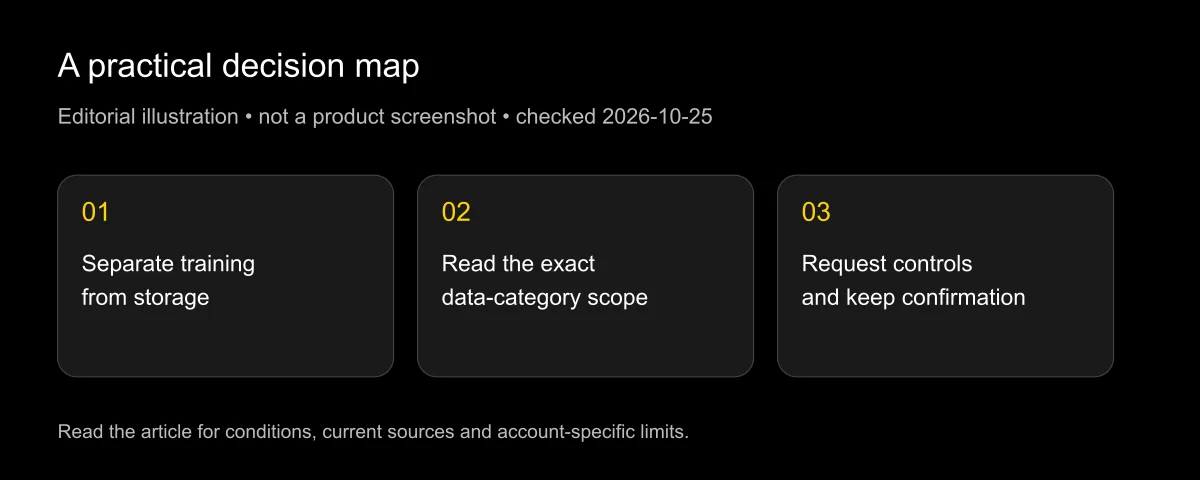
Some AI lip sync tools may retain uploaded photos or use relevant data for model improvement; others publish narrower exclusions for particular data categories or contracts. There is no industry-wide answer. Check the exact product, data type and agreement, and keep retention separate from training.
Checked: 2026-10-25. This review compares public documents, not internal systems. Policy statements, editorial inferences and unresolved questions are labeled below. LipSyncX publishes this guide and sells related products; we have a commercial interest in the category. The article is practical information, not legal advice or an independent privacy certification.
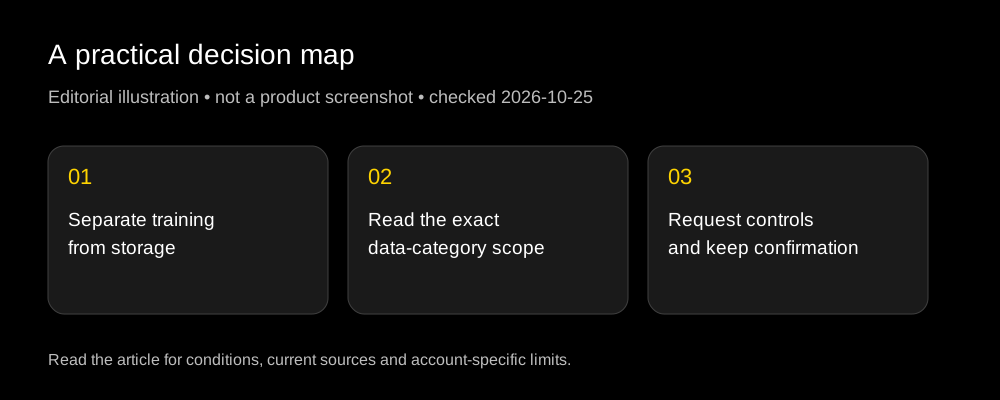
“Not used for training” does not mean “not stored,” and “deleted input” does not automatically mean “deleted avatar, output and backup.” Ask about each object and each purpose separately.
The current policy matrix
| Provider and reviewed document | Training statement | Retention / deletion | What remains to confirm |
|---|---|---|---|
| HeyGen general privacy policy | Model improvement and training are described; opt-out can be requested | Review the applicable personal-data and account rules | Account-specific contract and which data the request covers |
| HeyGen biometric notice | Specific consent-based provisions and enterprise exception | Different purposes and jurisdictions have specific schedules | Which provision applies to the exact avatar and verification data |
| Sync privacy policy | Includes developing, training and fine-tuning AI models | Purpose-based retention and deletion-request process | Exact self-serve input and derivative handling |
| Sync enterprise support | Zero-retention options are available to enterprise customers | Must be arranged for the enterprise account | Enabled scope, logs, outputs and backups |
| D-ID biometric policy | Biometric information excluded from improvement/training | Kept as needed for avatar maintenance, subject to applicable limits | Broader uploaded-content and anonymous-data scope |
| D-ID general privacy policy | Describes anonymized/de-identified research and improvement uses | Deletion requests with stated exceptions | Exact coverage of the assets in your workflow |
Sources checked: HeyGen privacy, HeyGen biometric notice, Sync privacy, Sync retention support, D-ID biometric policy and D-ID privacy policy.
Policy: these are limited summaries of written pages. Inference: use the narrowest justified conclusion rather than extending a clause to every file and feature. Not publicly established by this review: the actual data path for your account, audit logs, deletion completion or the contents of a negotiated agreement.
What is the difference between keeping and training?
Keeping means an object remains in some form: a source file, an avatar, a generated output, an operational record or a backup. Training means using information in a model-development process. A system can do one without doing the other.
A reusable avatar may need a retained representation to continue working. A project library may keep exports so you can download them later. Neither fact alone proves that the provider trains a general model on every uploaded photo.
Conversely, the disappearance of a visible input does not establish that no other derived object exists. A deleted thumbnail is evidence about that interface state, not a complete inventory of storage or past model processing.
Ask for a map rather than a slogan. For each object, list its purpose, storage location or service, retention trigger, deletion route and whether any training or evaluation use is permitted. That map becomes much easier to compare across providers.
What does HeyGen say, and what should you ask next?
HeyGen's general policy, updated October 15, 2026, includes the purpose “train and enhance the models” and provides a contact route to request an opt-out. It also distinguishes the treatment of business or enterprise customer processing under customer contracts. General privacy policy
The separate biometric notice, updated May 5, 2026, addresses face geometry and related purposes more specifically. It discusses consent, verification, avatar maintenance and training separately. For example, the EEA/UK/Swiss avatar-deletion provision describes destruction within 60 days; that is not a universal deadline for every data type or region. Biometric notice
The next step is not to pick one sentence and ignore the other document. Ask which provisions govern your product, region and data categories. Confirm how a general opt-out, biometric consent choice and any business contract interact for the account you will use.
Record the request's scope. “Please exclude this account's future uploaded photos and videos from model training” is more specific than “Please make my account private.” Ask whether the response addresses future use only or also retained copies of earlier uploads.
What does Sync say, and what should you ask next?
Sync's privacy policy describes model-development purposes, including “developing, training, and fine-tuning the AI models.” It also distinguishes account deactivation from a fuller personal-data deletion request. Sync privacy policy
Its support article, dated March 10, 2026, says zero-data-retention options are currently limited to enterprise customers. That is a route to discuss, not a default setting established for ordinary self-serve accounts. Retention options
For an enterprise inquiry, name the data objects you care about: uploaded photo or footage, audio, intermediate frames, generated video, logs and backups. Ask which are excluded from retention and whether the configuration is enabled before the first production upload.
If a marketplace hosts the model, review the marketplace too. A direct-vendor policy is not enough evidence about a file uploaded through another company's endpoint or workflow builder.
What does D-ID exclude, and where does the scope stop?
D-ID's biometric policy, updated December 19, 2024, states: “Biometric Information is not used to improve our products and services (nor to train the AI models that power them).” This is a specific written exclusion worth preserving. Biometric privacy policy
Do not expand that sentence into “every photo, output, operational record and third-party component is never used for improvement.” The general privacy policy separately discusses anonymous or de-identified information, research and service improvement. General privacy policy
The productive question is whether the specific file or derived object falls within the excluded biometric category, another content category or an anonymized-data provision. Ask for a written answer tied to the feature you intend to use.
D-ID also maintains an older Studio privacy page. Its presence is a reason to record document names and dates carefully, not to assume the oldest page overrides newer applicable terms. If the pages appear inconsistent for your use, request clarification before treating either one as a complete contract.
What is not established by a public policy comparison?
This comparison does not establish whether a particular photo was included in a training dataset. It does not inspect model weights, storage systems, staff access or backups. A legal permission to use data is not evidence that a specific file actually was used.
The reverse also matters. A test that generates one successful video cannot establish that the provider never trains on inputs. Quality tests and data-practice audits answer different questions.
We have not sent deletion or opt-out requests to these vendors on your behalf, and we do not publish private support correspondence as if it were an official amendment. Any customer-specific contract would require its own review.
This is why a “safe” or “unsafe” score without a documented scope is less useful than a matrix. A buyer can decide whether a known purpose, time limit or unresolved question fits their own project.
A six-step review before uploading client material
- Inventory the inputs. List people depicted, voice samples, confidential scripts, logos and any other sensitive material.
- Identify the full pipeline. Include the lip sync service, marketplace, voice provider, automation platform and storage used for URLs or exports.
- Read the exact documents. Save titles, effective or updated dates, checked date and applicable product or account family.
- Set or request available controls. Use the documented opt-out, consent or enterprise configuration and keep a private record.
- Test with permitted low-exposure material. Confirm the workflow before introducing more sensitive files.
- Close the project deliberately. Remove unused objects through supported controls, request needed deletion and save approved masters privately.
For a new test, use the talking-photo workflow only with suitable permission. The face-upload checklist helps decide whether a real person's face is necessary at all.
How should I write an opt-out or deletion request?
Keep the request specific and send it through the provider's current official privacy channel. Do not include additional sensitive media unless needed and requested through an appropriate process.
A practical template is: “Please confirm the training and improvement settings for my account and the product I use. I request the available exclusion from future training use. Please identify which data categories and dates this covers, any exceptions, and how I can verify the setting.”
For deletion, identify the project or assets privately and distinguish originals, avatars, voice templates and outputs. Ask what remains for backups, fraud prevention or legal obligations and what completion timeline applies.
These are editorial templates, not assertions that every jurisdiction grants the same rights or that the provider must honor every requested scope. Check the applicable policy and obtain advice for a specific dispute.
What if support says something different from the policy?
Preserve both statements with dates. Ask support to identify the applicable policy section, contract provision or authorized amendment. A reassuring sentence can be useful clarification, but it should not silently replace contradictory published terms.
Make the question concrete. Instead of “You don't train on my data, right?” ask whether uploaded portrait photos and derived avatar representations in your named product are used for general model improvement, and whether your account's setting excludes them.
If the answer only addresses biometric templates, ask about original images and generated outputs separately. If it only addresses storage, ask about training separately. A narrower answer may be correct without resolving the whole question.
For work with a strict no-training or retention requirement, do not upload first and negotiate later. Use an appropriately permitted alternative subject while the team obtains sufficient written terms.
A private record your team can reuse
Maintain one row per provider and product, not just per company. Include the document checked, date, applicable agreement, training statement, retention scope, deletion route, opt-out status and the person responsible for rechecking it.
Attach the relevant excerpt or saved policy copy privately where your team can find it. Avoid storing unnecessary personal identifiers in a public research file. A procurement record should help protect the data, not create a second uncontrolled copy.
Schedule a re-read before a major new campaign, contract renewal or changed feature. A vendor adding a reusable avatar, new model or third-party voice provider can change the relevant questions even when the product name stays the same.
Our commercial-use guide covers another separate decision: permission to distribute the final video. Data treatment and output rights belong in the same project record, but one does not answer the other.
FAQ
Does the tool keep or train on my photos?
It depends on the provider, product, data category and applicable agreement. Some reviewed policies permit training-related uses; others publish narrower exclusions. Ask separately about storage, training and derived objects.
Does deleting my account remove all training effects?
Do not assume that. Ask what deletion covers and what the provider says about prior processing, retained copies and trained systems. This review does not verify model unlearning or complete removal from backups.
Does enterprise always mean zero retention?
No. An available option is not proof that your account has enabled it or that it covers every object. Confirm the written scope and operational configuration before upload.
Can I use customer-service email as a public policy citation?
Prefer the current official policy or an applicable authorized agreement. A private email can clarify an account, but do not present it as a universal public commitment or publish personal details without permission.
What should a vendor correction include?
The public URL, applicable product and account scope, updated date, exact clause and an explanation of which matrix cell changes. A verifiable correction is more useful than a general assurance.
Ask for the scope before trusting the slogan
Open the relevant policy beside your project inventory and complete one row for every service receiving a file. If the terms fit, use a permitted sample in the lip sync workspace. Compare workflow categories in the 2026 generator guide before moving sensitive production material.
Update record: 2026-10-25: reviewed general privacy, biometric, Studio and enterprise-retention pages; separated explicit policy from inference and unverified operational behavior. Future editions should re-read these sources quarterly or after a material policy change. Corrections should identify the public document and scope rather than rely on an unsupported assurance.